
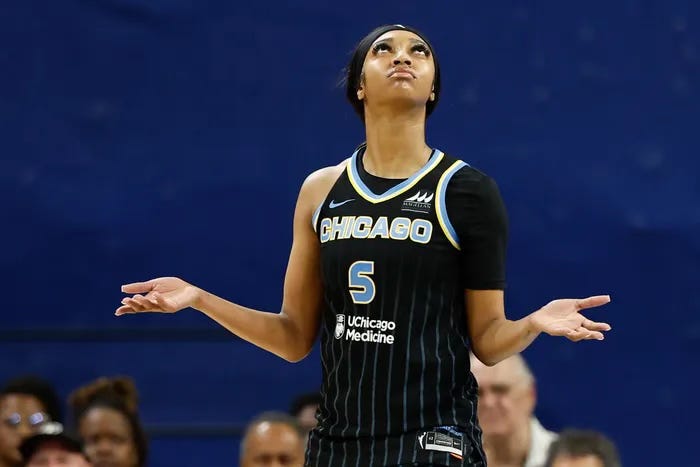
(Note: I know journalism calls for last name after first full reference, but to humanize Angel we’ll do away with that and call her by her name)
“Noise. Headlines. Hashtags.”
These are the first words of WNBA player Angel Reese’s commercial “Fuel” with Reebok for her debut shoe the Angel Reese 1s. “They talk like they know me. Like they built me. But I board anyway. They call it the hate train.”
In the first two seasons of Angel’s WNBA career, she has been a passenger on a train anyone would want to get off of: constant bullying, surveillance, the intentional misconstruing of her words and motives. But it wasn’t always this way for her.
During the 2010s, Baltimore’s high school sports went through this crazy renaissance of producing private school powerhouses like Calvert Hall and Gilman. The biggest standout was St. Frances Academy, who added some of the Baltimore region’s most sought-out recruits.
A young Angel Reese was one of them.
I was a witness, getting first tastes of sports journalism covering The Grassroots Youth Football League (GYFL), an organization home to DMV talents such as Los Angeles Rams running back Blake Corum and the Diggs brothers Stefon and Trevon.
In her athletic adolescence, Angel grabbed public eye as an integral piece of the dominant Team Takeover AAU basketball club, showing height advantage, quickness, and agility. So, once the hometown hero chose Maryland as a her first collegiate hardwood floor home, it was history.
Fast forward to her decision to transfer to Louisiana State University (LSU), their immediate success, including the coinage of Angel’s Bayou Barbie nickname, and their 2022 national championship that followed. It all sealed the deal on Angel’s rise as one of the most popular women’s basketball players.
But in that championship game, Angel returning the goodbye hand wave in now-Indiana Fever guard Caitlin Clark’s face which interrupted Angel’s stardom. Attention turned into something sinister. Something that hasn’t stopped.
The three-second celebration sprawled into an all-hate-rage against her beyond the court, beyond the game of basketball critique. Selected seventh in the draft, the vitriol followed Angel into the W. It’s turned into a witch-hunt, coaxed and covered in misogynoir, a concept coined by Moya Bailey that describes the specific experience of hate, antagonizing and dehumanization of Black women.
But, in Bailey’s 2021 book, Misogynoir Transformed: Black Women’s Digital Resistance, she takes it a step further, describing how the Internet’s depiction of real life rules digitize attacks on Black women.
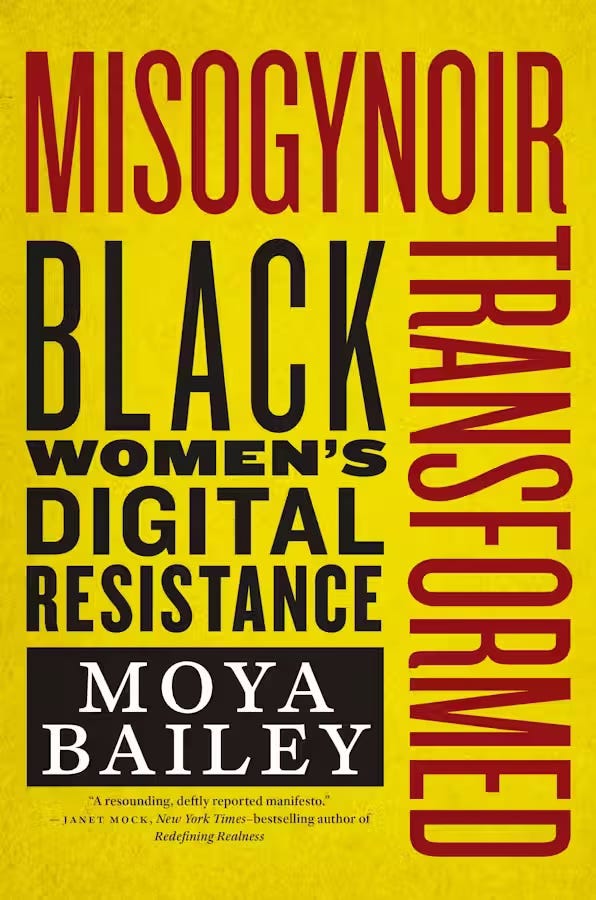
“Misogynoiristic caricatures materially impact the lives of Black women by justifying poor treatment through all areas of society and throughout US history,” Bailey wrote in her book’s introduction.
This is Angel’s exact experience.
Taking one game gesture out of context has opened the flood gates up for a digital finger-wagging that’s muddied into an ongoing citizen’s arrest that will persist until it physically breaks Angel into a spectacle. It’s one of those “lessons” whiteness likes to teach if you get out of “line” and become unapologetic about it.
So, in many Black women’s fashion, Angel nonchalantly embraced the villainy on June 4, 2024, accepting her “bad guy” role after a year of online torment and racism. Folks saw her agreement on a false narrative as a means for enabling. However, it doesn’t negate that, at the core of how Angel is treated, misogynoir lies at the foundation of her disenfranchisement.
We can no longer play oblivious about the ways sports reemphasizes real-life ethics and values, especially in the grand scheme of race and culture.
Too many racial incidents have transpired through the sports lens: Colin Kaepernick’s complete barring by the NFL, current Atlanta Dream Forward Brittany Griner’s imprisonment in Russia (where she wouldn’t even be if the WNBA’s pay was sustainably lucrative), even Taylor Townsend being told she has no class by her opponent Jelena Ostapenko at this year’s U.S. Open on August 27. It’s all connected to denying Black talent as a larger metaphor to the disenfranchisement and treatment of Black people in society. It echoes the same messaging that firing 300,000 Black women across the nation since “DEI” rollbacks rings.
Misogynoir’s digital form, however, emboldens the attacks from all fronts as the value of Black women is already a question within society. The worst part is, many are ignoring the reality and reason of Angel’s bashing for profit, a sick elevation of a league already growing its own wings to soar off the back of Black women’s pain.
Punishing Excellence: Attacking the Honest Achiever
We’ll get into the group bullying we’ve seen, but I wanted to make one small note of team groupthink. During a press conference, Angel was asked about how the team can elevate in the next offseason as their record stood at 10-31 at the time. They dropped three more games by season’s end.
Playoff hopes squandered and a hard season behind her, Angel responded candidly, honestly, saying: “I’m not settling for the same shit we did this year. We have to get good players. We have to get great players. That’s a non-negotiable for me. I’m willing and wanting to play with the best. And however I can help to get the best here, that’s what I’m going to do this offseason. So it’s going to be very, very important this offseason to make sure we attract the best of the best because we can’t settle for what we have this year.”
Chicago’s front office labeled her commentary “detrimental to the team,” suspending Angel for the first half of a game against the Las Vegas Aces.
You would think a player’s team would have her side, especially with only winning 10 games, but to have her reprimanded for it in the last stretch of the season seems like a power play that demands her to work with what she has.
Asking for excellence is not a crime. For Angel to be given this slap on the wrist shows a power play instead of acknowledging the elephant in the room: right now, The Chicago Sky are not good. And that is okay. But what is not okay is penalizing a player for honesty that everyone can see, even without knowing basketball fundamentals.
Angel deserves. We’ve seen the improvements of her game on rebounding, making shots, shuffling feet on defense just in year two. And as much as the Chicago Sky would like to pretend, Angel is a core reason for their 10-win success and she has the right to demand equal effort.
The way the Chicago Sky responded to Angel’s critique of the Sky’s potential was an egregious reach, but the league’s overall treatment of Angel opened the door for that.
The WNBA Idly Stands By
I am extremely disappointed in the WNBA Commission Cathy Englebert’s handling of the vitriol pointed toward Angel.
It’s other small things too, like granting Outkick, a publication with an extremely puzzling, racist past, media access, prompting them to question players about their relationships to Clark with no game context.
And then inviting sports figureheads, like Barstool founder Dave Portnoy, who’s been calling Angel everything except a child of God? Courtside? Meeting players? I personally believe there is a line of ethics that the WNBA needs to build out for the sake of diminishing misogyny and misogynoir in the league.
It’s why some of Caitlin Clark’s stardom feels like a real in-life version of Rocky. I was horrified to know that Rocky, a classic mind you, was made as a Great White Hope film to combat the issue of boxing’s Black dominance through the 60s and 70s as real-life boxers, Muhammad Ali, Joe Frazier, Sonny Liston, even Ismael Laguna took their place as sports royalty.
Clark is Rocky as the way Indiana Fever fans have become die hard MAGAts behind her and the other blonde bombshell teammates is a little scary, especially given they are seen as the angels against…Angel.
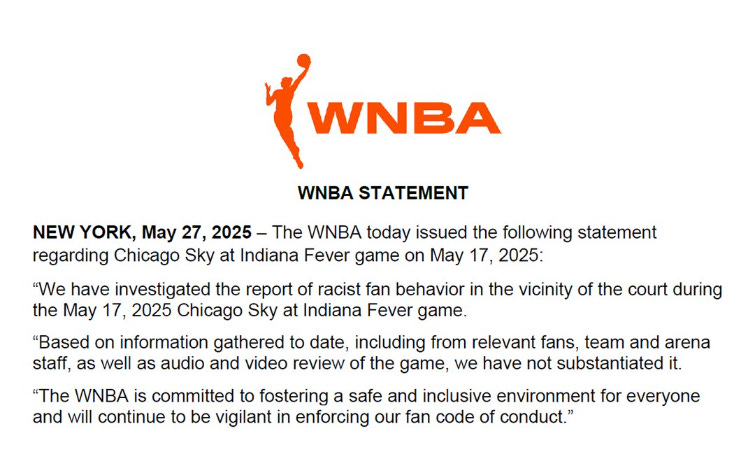
Hot mics caught the slurs flying in Indiana during the Fever-Sky’s first match to open the season, and the “investigation” found nothing to penalize anyone for. The league knows its place and how to handle the uncomfortable conversations. To see that they are seemingly ignoring the moral damage it facilitates by not checking the actual issue of Angel’s cyber and real-life bullies, so much so that other athletes feel the need to chip in too is glaring. And NO, that statement saying “racism bad,” was not enough.
It is true: we have never talked about the league the way we have since Angel or Clark’s arrival. And that’s in part to the continuous correction, overmatching and overseeing of Angel’s existence, let alone her behavior.
If the WNBA does not choose Angel, or any of their other players, over their priority of growing the game, the league will collapse on its own weight. I am not sure if the league will have the power to take back its product if it gets in the hands of the very racists and misogynists it’s been battling against since its inception. But I am also not sure if the league cares enough to self-audit or recognize how racism and sexism’s misogynoiristic blend hits its players. But, can we predict the league will be righting the wrongs to humanize players that society has already deemed unworthy? Bailey somewhat answers: “I argue that the silence and erasure of violence Black women and girls endure are connected to society’s inability to see them as worthwhile subjects deserving of respect and care, a sentiment exacerbated by misogynoir.”
This is also the same WNBA that platformed the mindless, “get back in the kitchen” trolling vitriol in a timeout commercial of WNBA LEGENDS clapping back at Internet fucks they should’ve never acknowledged in the first place. So now, how are we not making the concerted effort to truly take this moment to tell people to leave Angel Reese the fuck alone?
Players, Fellow Athletes Prolong the Violence
Other players are passengers on the Angel hate train too. Connecticut Sun Guard Bria Hartley did this back in the Sun-Sky game on June 15. As Angel went up for a rebound against the Sun, Hartley is seen grabbing one of Angel’s braids to prevent her from grabbing the rebound. Angel reacts viscerally, who wouldn’t, and it causes an internet frenzy because misogynoir’s dehumanization bars Black women from human reactions.
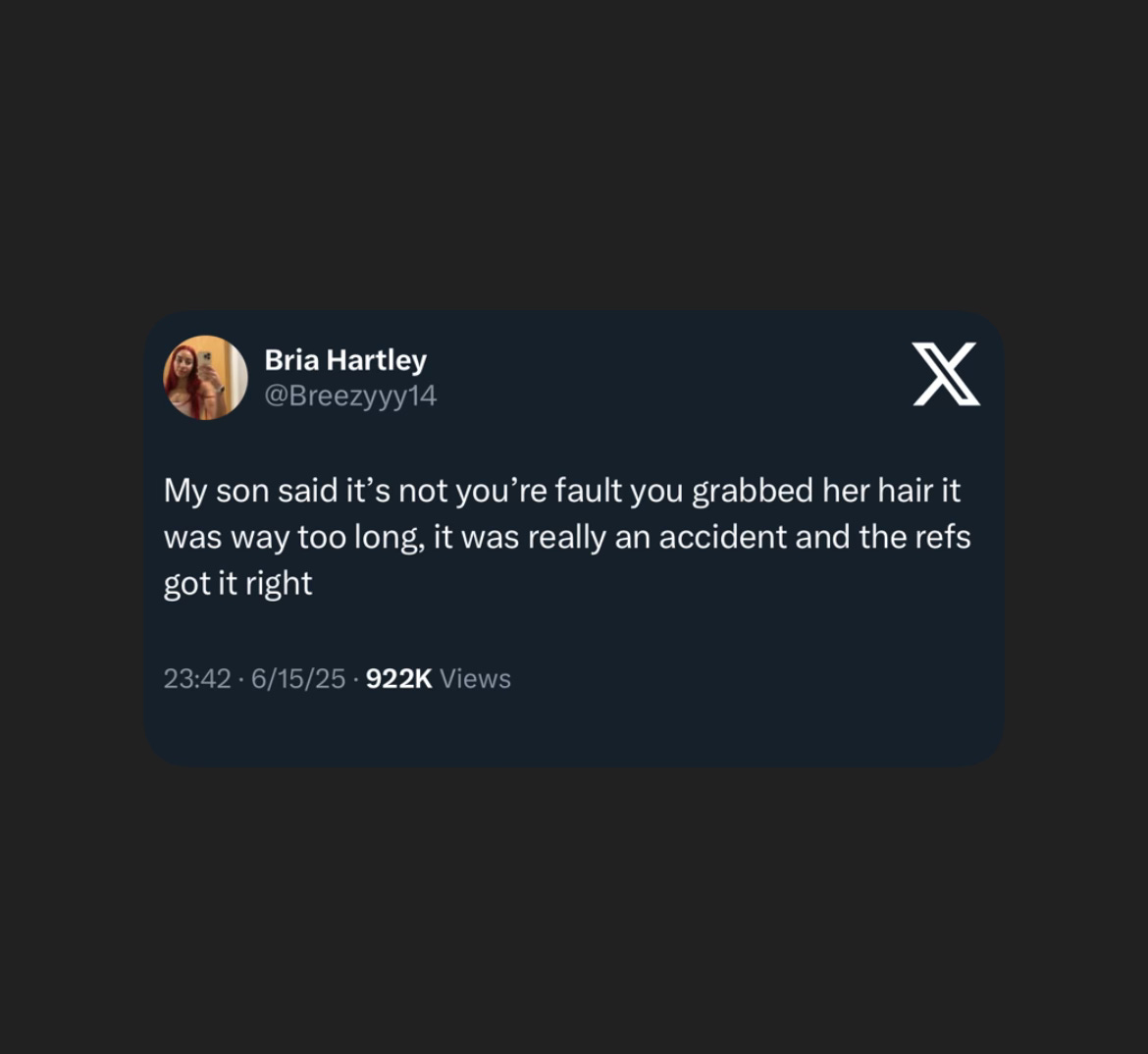
The refs did not call the flagrant foul nor did the league fine Hartlet for the egregious act. But, having a guilty inkling of the backlash, Hartley jokingly defended herself in the very place Angel is not welcomed: the Internet. “My son said it’s not you’re fault you grabbed her hair,” she posted on X, formerly Twitter, the app overridden by racist bots now (that are likely attacking Angel, too).
This is virtue signaling. Hartley plays on the racist tropes of Black hair being wild, unruly or “in the way” to prompt people to agree that Angel is responsible for her hair being “way too long.” Policing Black women’s hair is a classic out of the white overseer handbook.
Calling out Hartley’s behavior to other Black players too: she KNEW not to look Skylar Diggins in her face after a hard foul, but chirped once distance was made. Even with Los Angeles Sparks guard Rickea Jackson, that spat was incredibly preventable, but Hartley’s behavior toward fellow Black players seems to be too reoccurring for coincidence. Let’s also make note that the Angel situation is the only spat Hartley “cleared up” on X.
She tends to pick at fellow ballers who have a higher stock than her, and then scours to the Internet to indulge in misogynoir for a backup plan of self-righteousness. It’s outright bullying, but THANK GOD throwing stones and hiding hands leave faces wide open. (And who in their right mind throws their child under the bus to keep being vindictive when you’ve been caught?)
Outside the WNBA network? Robert Griffin III’s constant berating of Angel flood social media on multiple occasions: proposing that Angel has deep-seeded hatred for Clark off the court, then seemingly finding a false friend in Angel’s “inner circle” to prove that. He reshared a racist photoshopped 2K26 cover photo of Angel as a monkey too.
There’s true harm this footballer-turned-red-pill-analyst has done by even entertaining foul, racial depictions of Angel when trying to “defend” her from the very vultures he fed her to.
Though Griffin has not known relevance since about mid-2010s, building clout using misogynoir is evil. I am so tired of hearing from Black men when it’s time to reinforce a Black woman’s place. I am so sick of getting the word from someone whose pulpit is built on a digital throne of shit.
It’s gotten to a point where other men, former player and host Ryan Clark, who doesn’t follow the W closely, had to correct RGIII for the bullshit he spewed in light of buying into the racial dynamics that welcome harm against Angel. We even found out Clark got a white baby mama and a biracial daughter. (And y’all hide baby mamas like the FBI with Epstein files, but this made Clark the perfect person to speak out against RGIII.)
Many have come to Angel’s defense against the tomfuckery, like civil rights activist Bernice King, daughter of Rev. Dr. Martin Luther King Jr. (Sorry for cussing by your name auntie!). Her Chicago teammate Ariel Atkins had to pause a post-game presser to remind everyone that Angel not even 25 with too many targets on her name to count. “This is a 23-year-old kid, and the amount of crap she gets on a day to day, she still shows up,” Atkins said after their June 10 game against the New York Liberty, reigning WNBA champs. “Whatever questions y’all got about our team, basketball wise. We appreciate it but all the other nonsense? It’s irrelevant.”
Even Shaquille O’Neal’s warranted threats toward RGIII, though Shaq’s made some weird sexual comments to Angel and her short shorts, he’s a silver lining that the bullshit truly does not go unnoticed. (I believe any Black person thirsty for white approval has a humiliation kink, so I’m hoping RGIII’s large-scale lashing serve as a leather whip to bare ass.)
But I stand by the idea that if the WNBA were to protect Angel more than they are or have, no one would have the gall to speak so recklessly on who they think Angel is. There’s no ‘we’ve got your back’ commercial, or outright statements that center Angel and Angel only about the disruptive misogynoir that makes her out to be a villain, so much so, that she has to wear that identity like a badge of honor. Even if she does use hate as fuel, misogynoir and racism wear on the body. Its traumatic affects manifest harshly through ailments, diseases and trauma that’s stored for generations to come.
And I’m really on the WNBA like this because it’s a league that’s rested its laurels on being a progressive company with a pulse on society’s needs beyond the ball. They righted the wrongs of suspending players for protesting during the national anthem in 2016. The WNBA embraced retired guard Layshia Claredon when they announced their nonbinary, gender nonconforming identity, a first for any professional league. Former guard Riquana Williams was suspended for 10 games for being arrested in a domestic violence incident. Sedona Price going undrafted this year amid staunch abuse allegations is a testament to the WNBA’s network of paying attention to the morality of its fanbase. So the WNBA knows better, but will they do better? I personally believe the league will watch from afar while they stuff their pockets and give Angel a lifeless apology in 2046 when it’s all said and done.
Being Better Anyway: A Black Woman’s Perseverance
“More stops. More opinions. More pressure. More reasons on why I’m not supposed to be here,” Angel says in her commercial. “But I show up. Not for them, for the work. I don’t ride the hate train, I drive it and I own the tracks.”
After all, Angel is still a hometown hero. She has GOATs like Lisa Leslie and Tina Charles cheering her on (Candace was moving a lil…eh, but alas we move), along with the cool parts of culture uplifting her in music videos with Cardi B and Vogue placements to talk ball and serve face and fashion. Visibility in other pockets of sports doesn’t hurt either, so seeing her greet Terence “Bud” Crawford before his historic win against Canelo Alvarez was nice. Her Reebok shoes are super cute and all three color ways sold out within minutes. Who doesn’t like a quiet iridescent shimmer?
I’m happy to see this for her. As the case for many Black women, Angel’s perseverance is what keeps her. She has not given up on herself the way the world is trying to pressure herself into doing. Black women know best what it’s like when the truth is twisted to damage your character for any stereotype or rumored attitude you have or the tough time you are. Because, after all, the internet is not real. But its consequences are.